Saturday, March 5, 2011

this one remembers walking with Ath

On the track (Goanna (1)) IMG_5215
Goanna on the Basin track.

Ancient goanna
So nimbly climbing the tree
And hiding from us.

Millions and millions

Millions and millions of species.
And the Christian god favours the one
whose eyesight is surpassed by the eagle
whose speed is bettered by the cheetah
and whose nose cannot compare with his dog's.

And those new viruses
evolving to survive our antibiotics?
Why does this god not love and favour
his latest creations?


It seems to me that it is time for atheists to get political. Clearly, the Tony Abbotts of this world find it impossible to believe that their god could render his favoured species, the only species with a soul, extinct. For them, the thesis of man-made climate change is not believable. Yet all these characters who refuse to accept the science of climate change are happy to accept the science which makes medical breakthroughs possible or allows them to turn on a light.

Angophora costata IMG_3037
Angophora costata, Palm Beach, Sydney.

And what of trees? Why animals rather than plants? Surely 400 year-old living organisms are worth a thought.

Another haiku, another insect

An Ogmograptis
has scribbled for aeons on
E. haemastoma.

Scribbles IMG_3056
Scribbles on Eucalyptus haemastoma

E. haemastoma IMG_3051
Scribbly gums, E. haemastoma.


However, it seems now that Ogmograptis scribula has multiplied into many, many species.... In 2005, scientists discovered that various scribbly gum moths are very choosy in their diet, and that the local larvae (in Canberra) did not scribble on E. haemastoma. Different moths have different scribbles. I haven't yet been able to find the name of the moth which scribbles on this lovely tree. It seems it may not yet be named.
CSIRO: Scribbly gums interpreting their scribbles
Australian Museum: Scribbly gum moth

Friday, March 4, 2011

Still working on the haikus

If I hide in these sticks you might leave me alone
This beautiful katydid is from
Jean's photos.

The haiku is:

Pretty Katydid
hiding in dead leaves & twigs.
Don't move, Katydid.

Another, again based on
Jean's photos verticordia is

Green soldier fly
and pink Verticordia.
Each helps the other?

Green Soldier fly

haiku for the hexapod haiku challenge

Thrips & beetles
So needed in the sex life
Of the idiot tree.

Idiospermum australiense 040506-6504
Idiospermum australiense, the idiot tree.
Photograph courtesy of Tony Rodd.

Link to photo

For the pollination story, see Williams, G and Adam, P. (2010) "The Flowering of Australia's Rainforests A Plant and Pollination Miscellany", CSIRO Publishing, Collingwood, Victoria.

I have taken the following from
BlackDiamondImages

Idiospermum australiense, is the most famous of the primitive North Queensland rainforest plants having been considered extinct until it was found again just south of Cairns near Noah Creek in 1971. It has been called the Green Dinosaur Tree or otherwise,Ribbonwood. It belongs to an ancient 120 million year old family of plants only previously known from fossils. The fruit is very large, as big as a tennis ball and toxic to birds and animals. It is brown in colour and descibed as a woody nut by Cooper. It is believed however that the seeds were dispersed by extinct animals and birds. The tree produces fruit with some interesting characteristics. All modern flowering plants produce seeds which have either one seed leaf (monocots) or two seed leaves (dicots) but the seeds of the Idiospermum can have between 2 to 6 seed leaves! Normally seeds will germinate and send up a single shoot but the Ribbonwood can sprout more than one shoot per seed. The fruit is large at 80mm (3 inches) and globular, splitting into four segments on the ground. The spirally arranged flowers can range in colour from white or cream aging to pink, red or orange and are fragrant. The fruit contains alkaloids which can disrupt nerve transmission to the brain. This rare species is only found from Noah Creek to the Daintree River and from the Mt Bellenden Kerr Range to the foothills of Mt Bartle Frere in lowland rainforest up to 260m altitude.
Source-Plants of Tropical North Queensland by John Beasley p.106 plus Cooper and Cooper 2004, P.232

4th Annual Hexapod Haiku Challenge

Monday, February 28, 2011

One more chapter

Commelina cyanea IMG_2991
Commelina cyanea, Native Wandering Jew, Norma Road, Palm Beach.

Only swimming on weekends, and I spotted this beautiful blue, walking to the beach.
Just one chapter to go, the final summary and discussion. All other chapters have had at least two drafts, the papers to be published or published about 7 drafts. The last substantive chapter is now in second draft......
Two weeks before I submit to the internal examiners... So, quite a bit of work to go.

Monday, February 21, 2011

theses and botanising

I am currently writing up my thesis, and taking an inordinately and unnecessarily long time to do so. I have been on only one botanising walk, since my return to Sydney. (So, two photos from that walk.)

And here at work (avoiding work) I found a specimen from the NSW herbarium's record, with a photo of an actual plant collected by Banks and Solander. (If it is not from Banks & Solander, then it does come from the British Museum Collection..) Such an incredible collection. (Click to see it...)
Plantnet Acacia julifer


IMG_2517
Casuarinas and banksia on Barrenjoey Headland.

Tea Tree IMG_2574
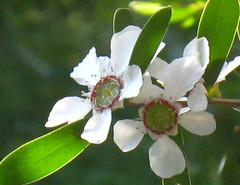
Leptospermum squarrosum, a lovely tea-tree common in the coastal scrub.

Given that Acacia julifera was collected by Solander and Banks, here is a photograph of a beautiful tree planted, I think, in the 19th century, and a plant in the Botanic Gardens whose plaque says "Not collected by Banks and Solander". It is a magnificent tree.

Eucalyptus grandis IMG_3964
Eucalyptus grandis.